Chino: Elevating Visual Identity with Bold Decorative Typography
In the crowded landscape of digital design and print media, capturing attention within a fraction of a second is the primary challenge for creators. Chino emerges as a solution specifically engineered for this high-stakes environment. It is not a typeface designed for long-form reading or subtle background textures; rather, it is a stunning decorative display font intended to serve as the absolute center of attention. For designers, marketers, and business owners who feel constrained by safe, conventional typography, Chino offers a distinct visual personality that breaks away from the ordinary while retaining a polished, professional finish.
Understanding what Chino actually is requires looking beyond standard font classifications. It is an artistic tool that bridges the gap between custom lettering and functional typography. While many decorative fonts sacrifice legibility for style, Chino maintains enough structural integrity to function effectively in commercial settings. Its unique artistic elements provide the handcrafted feel of bespoke illustration with the scalability and consistency of a digital font file. This balance makes it particularly valuable for professionals who need to deliver high-impact visuals without spending hours drawing custom letters from scratch for every new project.
Strategic Applications in Branding and Packaging
The most immediate application for Chino lies in brand identity systems where differentiation is critical. For entrepreneurs launching artisanal products, boutique retail stores, or creative agencies, the logo serves as the first point of emotional connection. Using a generic sans-serif can sometimes signal "corporate" or "impersonal," while overly ornate scripts can feel dated. Chino occupies a modern middle ground. Its bold, uppercase forms create a solid architectural foundation for logos that need to be memorable on social media avatars and legible on physical signage.
Consider the specific scenario of product packaging. A coffee roaster, craft brewery, or cosmetic brand competes for shelf space against hundreds of similar items. In this context, typography acts as packaging architecture. Chino’s strong visual weight allows it to anchor a label design, guiding the consumer’s eye directly to the brand name or product variety. Because the font features unique artistic details, it adds texture and perceived value to the packaging without requiring additional graphic elements. This efficiency is crucial for small business owners managing tight production budgets; the font itself does the heavy lifting of establishing premium quality.
Digital Content and Social Media Impact
For content creators, bloggers, and social media managers, the thumbnail or cover image determines click-through rates. Chino excels in these high-contrast digital environments. When designing YouTube thumbnails, Instagram carousel covers, or Pinterest pins, readability at small sizes is non-negotiable. The bold nature of this display typeface ensures that headlines remain crisp even when compressed by platform algorithms. Unlike thinner decorative fonts that disappear against busy photographic backgrounds, Chino holds its own, allowing creators to overlay text confidently over complex imagery.
Educators and course creators also benefit from this typographic strength. When designing slide decks, webinar banners, or certificate templates, hierarchy is essential. Chino functions exceptionally well as a tier-one heading, instantly signaling to students or attendees that they have arrived at a major topic or module. By reserving this distinctive font solely for key concepts or titles, educators create a visual rhythm that aids information retention. The font’s professional polish prevents educational materials from looking amateurish, helping independent experts establish authority in their niche.
Navigating Technical Specifications and File Formats
Practical implementation requires understanding the technical assets provided with Chino. Users receive both OTF (OpenType Font) and TTF (TrueType Font) files, each serving different workflow needs. The OTF file is generally the preferred choice for professional designers using Adobe Illustrator, InDesign, or Affinity Designer. OpenType format supports advanced layout features and typically renders more smoothly in vector-based software, making it ideal for logo design and large-format printing where precision is paramount.
Conversely, the TTF file ensures universal compatibility across devices and platforms that may not fully support OpenType features. This format is invaluable for freelancers delivering editable templates to clients who might be using older versions of Microsoft Word, PowerPoint, or Canva. If you are a designer creating brand guidelines for a client’s internal team, including the TTF version ensures they can access the brand font regardless of their software ecosystem. Having both formats eliminates the friction of "missing font" errors during collaborative projects or handoffs.
Critical Design Considerations Before Purchase
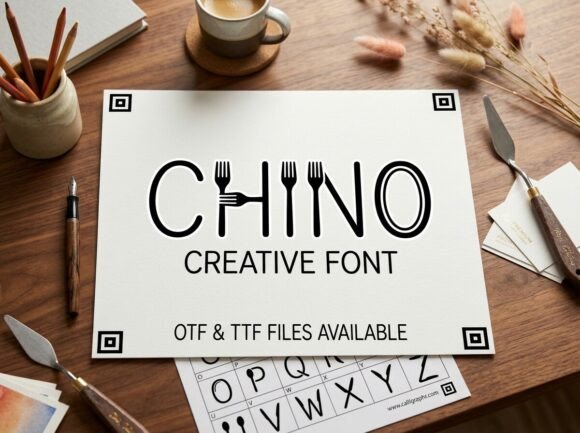
Before integrating Chino into your asset library, it is vital to address its specific functional constraints to avoid workflow disruptions. This font is an ALL-CAPS Uppercase Only display typeface. It does not include lowercase letters. This is not a limitation but a deliberate design choice that defines its use case. Typing in lowercase keys will still produce capital letters, ensuring uniform height and visual impact. However, this means Chino is unsuitable for body copy, captions, subheads requiring sentence case, or any interface element relying on mixed-case legibility.
Users should evaluate their current project needs against this constraint. If you require a versatile family for an entire website or a 200-page book, Chino should be paired with a complementary sans-serif or serif for secondary text. Think of Chino as the lead vocalist, not the backing choir. It works best when used sparingly for maximum effect. Attempting to force this display font into paragraph text will result in poor readability and visual fatigue. Successful application involves restraint; let Chino handle the headlines, logos, and decorative initials, and allow a neutral typeface to manage the narrative content.
Real-World Scenarios for Diverse Creators
The versatility of Chino extends across various lifestyle and commercial sectors. Event planners and wedding stationers find immense value in its ability to convey celebration without cliché. For modern weddings or corporate galas, Chino provides a contemporary alternative to traditional calligraphy. It reads beautifully on acrylic welcome signs, menu cards, and event programs, offering a bold aesthetic that photographs well in venue lighting. The uppercase-only structure creates clean, justified text blocks that look intentional and structured in printed collateral.
Freelance designers working with multiple clients appreciate Chino as a reliable "wildcard" option. When a client requests something "fun but professional" or "bold but elegant," this font often satisfies that vague brief. It avoids the playfulness of bubble letters and the severity of industrial grotesques. For merchandise designers creating t-shirts, tote bags, or stickers, the font’s inherent character reduces the need for complex illustrations. A single word set in Chino can carry enough visual interest to stand alone as a complete design, streamlining production time and reducing ink costs in screen printing.
Ultimately, selecting Chino is a strategic decision about visual communication. It signals confidence and intentionality. Whether you are a marketer trying to stop the scroll, a publisher designing a book cover that demands shelf presence, or a hobbyist personalizing a gift, this typeface delivers specific outcomes. It transforms standard text into a graphic element, saving time on custom illustration while providing a cohesive, professional look. By respecting its all-caps nature and deploying it in appropriate high-impact contexts, users can leverage Chino to create work that is not only seen but remembered.